

Resilience thrives off the imagination.

That philosophy drives The Color Purple, the latest adaptation of Alice Walker’s seminal novel. The story has persisted through its multiple version but still squeezes the soul. The film follows Celie (Phylicia Pearl Mapsi and Fantasia Barrino) as she experiences decades of abuse at the hands of brutal men, including her father and her husband, “Mister” (Colman Domingo). Amidst the brutality, Celie finds solace in the women in her life. She is brutally separated from her sister Nettie (Halle Bailey) when “Mister” attempts to rape her one evening, eventually believing she is dead. Her step-daughter-in-law Sophia (Danielle Brooks) offers her models of self-defense against physical and mental domestic violence. Shug Avery (Taraji P. Henson) is the most transformative figure, a swaggering blues singer and Mister’s occasional lover who also charms Celie. These relationships allow Celie to endure life at its worst to discover her best self.
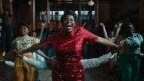
Director Blitz Bazawule brings Celie’s journey of self-discovery to the screen with a ferocious imagination. The Color Purple is startling in its invention, especially in conceiving its splendid musical numbers. Bazawule enhances the original musical compositions by Brenda Russell, Allee Willis, and Stephen Bray with intricate choreography, eye-popping costumes, and grand set design. His camera moves fluidly through the numbers, whipping around the ensembles without missing a beat. The musical sequences also never feel restricted by their stage origins, with Bazawule taking big cinematic swings with them. The strongest ones dance at the edge of fantasy and real life. “Dear God – Shug” is a stunning figment of Celie’s imagination, set on a gigantic gramophone. “What About Love” casts Celie and Shug in a fantasia (heh) heavily inspired by the classic Hollywood pairs of Ginger Rogers and Fred Astaire and, especiall,y the Nicholas Brothers.

Bazawule’s imaginative direction allows him to showcase Black communities’ unique power and limits. He covers a wide breadth of the traditions and customs of Southern Blackness through the musical numbers’s dizzying pace. Spirited choreography is how “Mysterious Ways” and “She Be Mine” tap into the reinvigorating possibilities of Black spirituality, while “Workin’” and “Hell No” use it to reinforce and deconstruct gender roles and domestic violence. The film occasionally interrogates how Black community traditions can fail its members. However, Bazawule seeks to spotlight the enduring joy amidst the darkness at the fringes and foreground of his characters’ lives. His effort is largely successful, joining other Black artists in demonstrating the complexities of Black trauma without gratuitously dwelling on it. (Sexual violence is a present theme throughout the story, but Bazawule finds artful ways to keep it to the periphery.)
The Color Purple’s fluid movement makes for rousing musical performances but can dampen the characters’ development and undercut its narrative. One of the most powerful scenes – Sofia confronting Celie about Harpo beating Sofia on Celie’s advice – feels oddly truncated. Some emotional beats appear to be lost in the editing process, blunting the betrayal’s impact. (It pales in comparison to the 1985 film’s scene with Whoopi Goldberg and Oprah Winfrey.) Celie can often feel underwritten, with few opportunities to explore her young adult mindset after decades of subjugation and violence. Other characters, like Mister, Sofia, and Harpo, similarly have moments of change either glanced at or skipped over. Given its insistence that possibility of redemption in the worst circumstances, the film could’ve tracked it more closely.

Despite the slight characterizations, The Color Purple’s cast compensates with excellent performances. The script mutes Fantasia Barrino’s first moments, but she is blisteringly alive in the musical numbers, communicating a joyous, sensuous interiority. Colman Domingo is terrifying and pitiful as Mister, a powerful condemnation of the cyclical nature of toxic Black masculinity. Taraji P. Henson terrifically counters Barrino and Domingo, unlocking their characters’ true natures with her indelible bawdiness. More than just a saucy foil, she has profoundly affecting moments of sadness at the harm she witnesses in Mister’s home.
And then there’s Danielle Brooks. She is an explosive force from the second she blows across the screen as Sofia. She electrifies an already-charged atmosphere with her all-consuming presence. Taking your eyes off Brooks feels like a betrayal, lest you miss an iconic moment, like Sofia tossing Harpo’s tea in the ocean. She is equally adept at searing drama as firecracking comedy, rendering Sofia’s soul-shattering arrest with aching clarity. Aside from elevating her fellow actors, Brooks pushes the entire production forward with her indomitable spirit. She gives one of the year’s best performances and one of the best in a movie musical. At the very least, the film would be less without her.

As ubiquitous as Alice Walker’s text is, The Color Purple forges its own path of vitality. Blitz Bazawule challenges convention with impressive innovation that centers Black joy and resilience above all else. The film sweeps its audiences up in its blend of imaginative fantasy and intense reality. It’s accessible to all audiences, yet sharply and unapologetically tailored to viewers familiar with the Black American experience. Even at its weakest, The Color Purple feels like a triumphant continuation of a critical legacy in Black artistry.
![Pedro Pascal Discovers the Power of Music in the Handsomely Staged ‘Behemoth!’ [NYFF 2026]](https://whenthingsgopop.com/wp-content/uploads/2026/10/BHMTH_SG_18138_V1.jpg)



Leave a Reply