

What value does a story have when you know the ending?

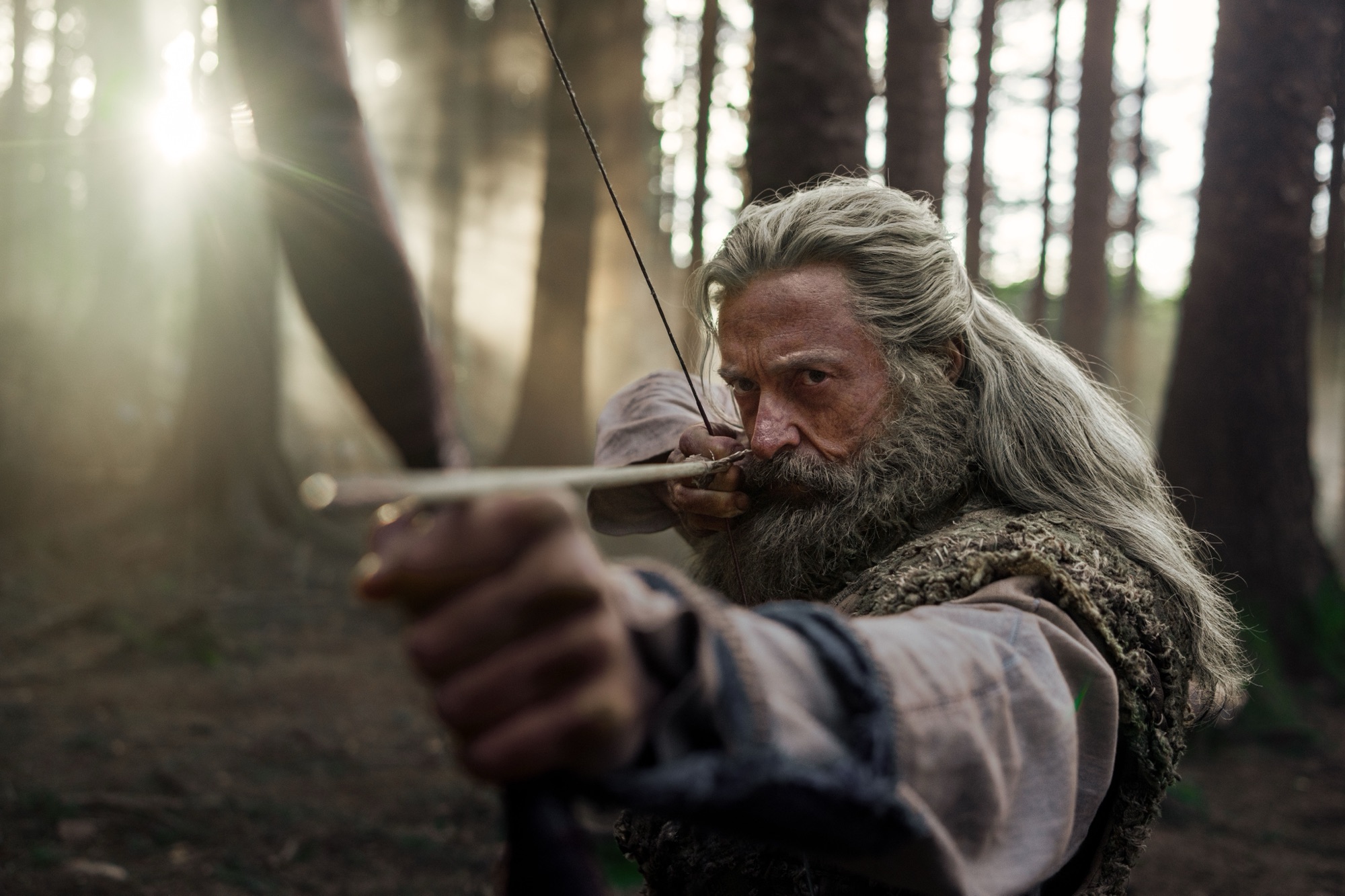
That question drives The Death of Robin Hood and its titular legendary hero, played by Hugh Jackman. Robin, or at least this older, grizzlier version of him, knows he’s at his endgame. He’s slower, grayer, and more injured than the “steal from the rich, give to the poor” folktale regards him. He’s also made a slew of enemies who would love to string him and his band of thieves up by their ankles. Robin is still remarkably skilled with his trusty bow and arrow, but he’s one wrong step from a stony grave, similar to the one he buries a foraging young girl in after she tries to kill him for his resources. Robin’s aging physicality isn’t even the greatest threat to his life. That dubious honor belongs to the crippling self-loathing cast by the outsized shadow of his own mythos.
As for The Death of Robin Hood itself, filmmaker Michael Sarnoski has set out to introduce a novel take on one of the most enduring characters of English folklore. With Robin Hood’s aforementioned spiel being table stakes, Sarnoski’s novelty comes from the hero’s titular, promised demise. It is something of a risk. In today’s fragmented, risk-averse culture, asking audiences to spend two hours waiting for Robin Hood to die is a tall order. Yes, the journey is the destination here, but modern cinematic wisdom suggests that you can’t just throw an older, grizzlier version of a beloved character on screen and demand our attention (see Ethan Hunt and Indiana Jones).

What you can do is upend audience expectations of how such a story should unfold. Starnoski unfolds The Death of Robin Hood in reverse. Those expecting the film to end in a violent barrage will be stunned by the carnage’s immediacy. Sarnoski is unsparing in depicting Robin Hood’s brutality, with each slice and stab landing with a heavy slam. He lingers within the violence, holding the camera on an arrow sticking out of a child’s eye or a bandit’s jaw hanging by sinew so we can’t escape. The horrors are jaw-dropping in their stark gnarliness and confounding beauty. Cinematographer Pat Scola composes some unbelievably striking shots, using askew angles and wide-scale framing that imbue the relentless brutality with a Gaelic mysticism. Scola and Sarnoski dare you to be transfixed by what should be abhorrent. Our acquiescence feels like a stinging indictment of how society, Robin’s and our own, glorifies violence.
That sting is at the core of Robin Hood’s torment, and the film zeroes in on it as the first act’s violence recedes. After an especially brutal battle to rescue Little John’s (Bill Skarsgård) family, Robin is taken to a priory on a remote island to convalesce, run by Brigid (Jodie Comer), a gentle but focused nun. Sarnoski slows the breathless pace and dials down the physical intensity to focus on Robin’s recovery, both physical and emotional. The tonal shift is disorienting but, surprisingly, not alienating. After so much vicious, retch-inducing pain and gore, the breather is appreciated. What’s even better is the opportunity to contextualize that violence through the man himself, the man who rejects the moniker of hero. Is a man who can slam a knife into a child’s temple capable of redemption? Does he deserve it? Who is worthy of deciding whether he deserves it?

Robin’s encounters within the priory tackle those questions. Robin discovers that his actions as an outlaw have had far-reaching effects, even on a convalescent home on a remote island. To his surprise, the results vary, as do the responses to those effects. Margaret, Little John’s daughter, sees Robin as a source of safety and mentorship, someone who manages to break through her unspoken but palpable trauma. For The Leper (Murray Bartlett), Robin is a protector who can carry on after the Leper succumbs to his terminal illness, but only if he can cast aside his ghosts. The faith that The Leper bestows on Robin and the possibility of redemption make for one of the film’s most emotionally stunning moments. That shot at redemption is extended to Godwin (Noah Jupe), a young man who is about to step onto Robin’s path of cyclical revenge and violence.
The deconstruction of Robin Hood is made even more fascinating by Sarnoski’s retention of the same mystical atmosphere that permeated the violent first act. Instead of challenging the concept of violence as jagged beauty, Sarnoski mythologizes redemption through gorgeous wide landscape shots and spell-binding sequences of natural elements. Even though the film, or our assumptions about it, points to Robin’s salvation, Sarnoski makes it feel cosmic enough to be just beyond his grasp. Tragically, that limited reach ties directly to Robin’s final, most complicated connection to the priory. Through Brigid, Robin realizes his redemption is not simply possible, even if one of his most tragic victims could see a path of forgiveness. Her forgiveness is irrelevant if Robin can’t forgive himself. In a spate of beautifully tragic irony, Robin’s acceptance of his damnation is his salvation, paving the way for his inevitable but emotionally shattering end.

Robin Hood’s journey of hellbound salvation wouldn’t be nearly as affecting without Hugh Jackman. He has great experience with older, grizzlier versions of beloved heroes through Logan, and there are inevitable similarities to be drawn between that film and The Death of Robin Hood. Jackman expands upon his exemplary work as Old Man Logan, playing Robin with a grounded, gruff practicality that points to wounded grace at Robin’s most vulnerable moments. Those two modes combine beautifully when Robin finally passes, with Jackman’s weathered tone and weakened eyes conveying Robin’s resignation and relief at his fate, making for one of his best moments on screen. The cast surrounding him does similarly great work. Jodie Comer and Murray Bartlett match Jackman’s grace with quiet, lived-in performances, while Bill Skarsgård’s feral adrenaline pushes the film’s violence to the max.
The Death of Robin Hood finds value in the legend’s inevitable ending through the least conventional path imaginable. The path may be stained in blood and grime, and clouded in confounding and captivating mysticism, but its stunningly clear-eyed look at the limits of legacy and redemption makes the stumbles well worth the journey.
![Pedro Pascal Discovers the Power of Music in the Handsomely Staged ‘Behemoth!’ [NYFF 2026]](https://whenthingsgopop.com/wp-content/uploads/2026/10/BHMTH_SG_18138_V1.jpg)

Leave a Reply