

One of the greatest compliments you can pay to a musician is that their music serves as the “soundtrack to our lives.”
Usually deployed during a Lifetime Achievement presentation at an awards ceremony, the compliment suggests that one’s work is so omnipresent and impactful that it is virtually inextricable from the public consciousness. Narrowing the aperture a bit, it says that a song or track will embed in our collective memory. It evokes a powerful feeling or moment we will always carry with us.

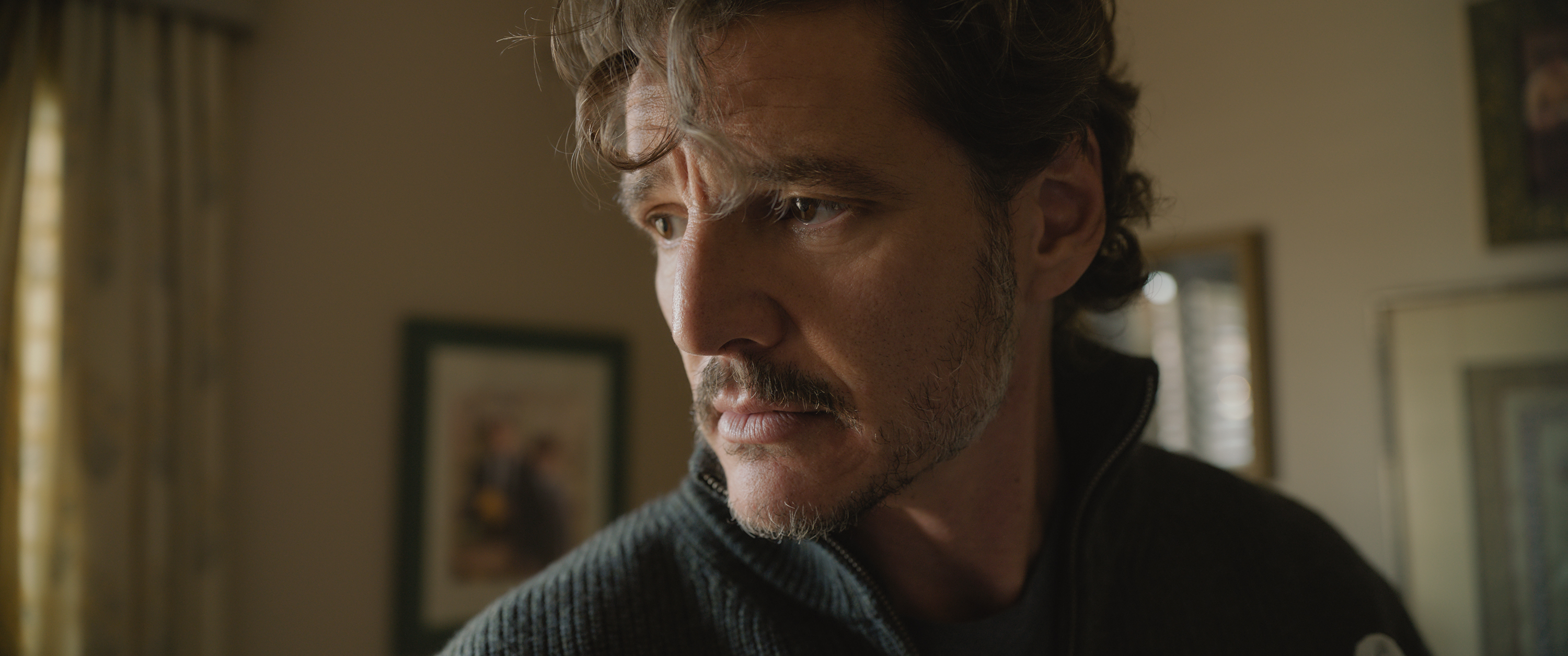
Tony Gilroy explores this phenomenon’s power in Behemoth!, which world-premiered at the 64th New York Film Festival. The film follows Alex Serian (Pedro Pascal), a prodigious cellist scoring a soon-to-be-released blockbuster. His performances of the different tracks transport him through his own life, allowing us to glimpse the dysfunction that has led him to this particular gig. We learn that he is the child of two temperamental orchestral music legends who have used him and his brother Andy (Will Arnett) as weapons against each other. We see his inability to form meaningful romantic attachments because of it, first with wealthy patron Carol (Olivia Wilde), and then with violinist Nadia (Eva Victor). Alex’s past and present ultimately collide when he discovers a newfound personal connection that upends his lack of passion for life and its melodies.
Music is how Behemoth shapes itself, narratively, thematically, and, in an inventive twist, structurally. The film follows a nonlinear chronology, weaving in and out of Alex’s past, bouncing between his various performing stints. Our anchor is the Barbra Streisand Scoring Stage on the Sony Pictures lot, where Alex and the other contract players are recording the film’s score. Where we land in Alex’s past is determined by the music he must play. (The Behemoth Collective, a gallery of legendary film score composers, from Alan Silvestri to James Newton Howard, wrote the music.) Playful, pulse-pounding orchestration soundtracks his most frenetic, comic experiences, mostly involving the mercurial Carol. His moments of flighty, fancy romance lull you into a blanket of soft, elegant strings.

It is an unusual, intriguing approach to storytelling. Behemoth invites us to engage with character and worldbuilding through music, which is often secondary to other elements such as dialogue, costumes, and production design. The initial novelty of knowing Alex this way is appealing. Tony Gilroy’s appreciation of film music is evident, and he sweeps you along with his thoughtful, intimate curation of cues. Combined with elegant direction, which frames scoring with accessible reverence, it’s easy to understand why Alex chose this craft.
What’s less clear over time is who Alex actually is. Behemoth’s time-hopping becomes harder to parse into a coherent chronology. It seems the film is tracking backward to reveal the inciting incident that led him to the present-day session. That narrative logic is abandoned halfway through the film, making it difficult to understand Alex’s character evolution. Further complicating that challenge are Gilroy’s slight explorations of Alex’s interpersonal relationships with friends, family, and lovers. The film presents Alex as a charming, aloof playboy, but doesn’t detail what about him attracts his inner circle, and vice versa. What about Alex would make Carol storm through a Chicagoan blizzard to chase after him? Why would Nadia risk her relationship with her fiancé to stay in Alex’s distant orbit? Is it his talent or his demeanor? The film never quite says.

Alex’s passivity as a protagonist might be the source of the problem. By design, the film often has things happen to Alex rather than Alex doing things himself. (His most active choice is to escape from Carol in the Chicago blizzard.) Alex effectively sleepwalks through life, coasting on the inevitability of his talent, with few opportunities to wake him up. The lack of internal or external introspection can be alienating and rob some narrative beats of their power. One character’s funeral is intended as Alex’s clarifying moment, but the scene’s lack of buildup leaves it oddly unemotional. His reaction to their death, and their fleeting moments together, make you question why they matter to him.
The third act finally grants Behemoth its pulse, as Gilroy brings the disparate threads together into a genuinely moving conclusion. We understand what Alex has been missing, which enriches both his self-regard and his passion for music, which had been neutered by his status as a prodigy and by his parents’ psychological mistreatment of him and Andy. That shift does wonders for Pedro Pascal. Pascal cuts a wildly appealing figure, leaning hard into his natural charisma to fill gaps in his character development. Once the script catches up, however, Pascal blossoms. His expression, especially his eyes, sparkles with admiration and respect for his art form during the final session, while his posture carries just a hint of shyness about needing recognition. He makes you feel like Alex is discovering and embracing his purpose for the first time. It is a deeply moving performance.

Behemoth! is two character studies in one: one of music and one of Alex Serian. As a study of the former, the film is a resounding success. Tony Gilroy handsomely conveys film music as a meaningful function of memory and emotion. It is slightly less successful as one of the latter. Gilroy handsomely stages it, but a bit too distant from its musical prodigy to register the same impact. Collectively, the film does ring true about the power of music to help us better understand ourselves, arguably the best example since the era of VH1’s Save the Music Foundation. At a time when music, like all art, is under active threat from technologies that seek to strip away its human element, Behemoth is of great value, even with its shortcomings.



Leave a Reply