

A recurring joke about Ronan Day-Lewis’s Anemone is the difficulty of pronouncing its name. At the New York Film Festival, where the film is world premiering, several critics, myself included, tripped over the syllables. Even one of the festival’s representatives hoped that they hadn’t mispronounced it at its press screening.

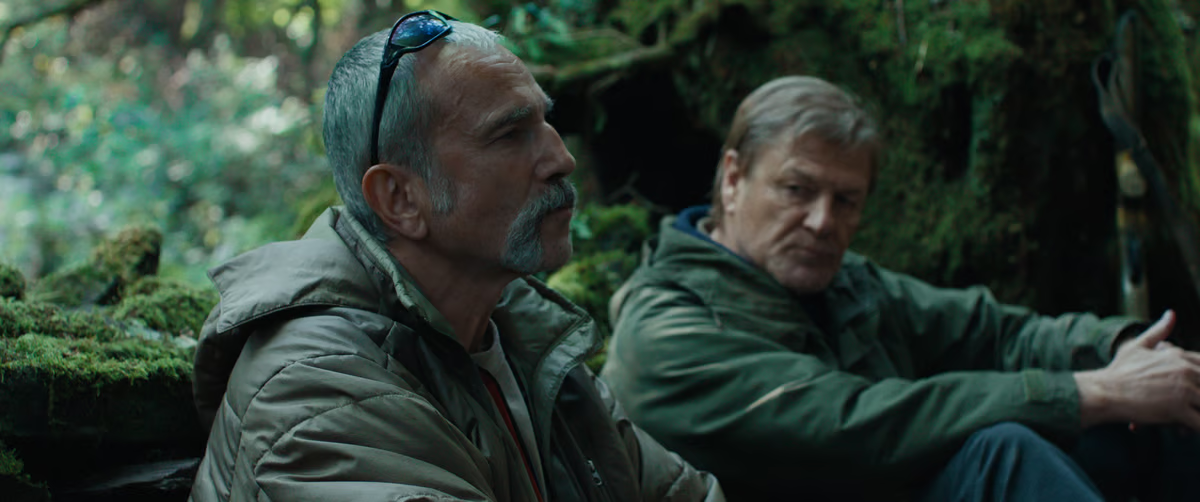
In hindsight, the title’s ambiguous pronunciation feels well-aligned with Day-Lewis’s ambition for his film. Anemone centers around two brothers, Ray (Daniel Day-Lewis) and Jem Stoker (Sean Bean), reuniting after twenty years of estrangement. Jem travels to Ray’s cottage in the woods because Ray’s teenage son Brian (Samuel Bottomley) is struggling emotionally. Jem, who raised Brian as his own with Ray’s ex Nessa (Samantha Morton), believes Ray’s presence would solve Brian’s problems. Ray has no interest in abandoning his reclusive life in the woods for anyone, and Jem isn’t leaving without him. The brothers spend their begrudging days swimming, hiking, and punching each other towards a reconciliation. What looms over that reconciliation is their past fighting as soldiers during The Troubles in Northern Ireland.
The troubles of Northern Ireland and the overall past are the driving forces behind Anemone, although it’s not immediately clear. The film’s first 20 minutes have very limited dialogue, focusing on Jem’s journey through the woods and Ray’s chores. Our initial understanding of the Stokers’ estrangement comes from the ethereal environment that Ronan Day-Lewis captures through his lens. He taps into the colors and movements of Ireland’s wilderness to craft uniformly beautiful images. (Day-Lewis is also a painter, and his keen eye for striking landscapes is evident.) His shots — the bluish-greens of the nighttime fields, a purplish sun in the horizon — hint at an invisible mysticism. He weaves Bobby Krlic’s beautifully grungy score, rattling with revolutionary verve, through those surrealist, spiritual scenes. The contrast works surprisingly well to form a discordant but enveloping atmosphere.

Anemone’s atmosphere suggests that larger forces, that we won’t be privy to right away, are at work against the Stokers. Even after Jem finally reaches Ray’s cottage, there is no warm welcome or booming rejection. All Ray can offer his brother is a dismissive wave towards a block of wood to use as a chair. The stakes are high, as we see through close-ups of Brian’s beat-up knuckles and Jem’s paper with Ray’s coordinates. And yet, Day-Lewis pushes ahead with the silence, even as it risks alienating us. It doesn’t help that no one else knows the reasons behind Ray’s isolation. Nessa and Brian’s few scenes leave them in limbo as Day-Lewis takes his time bringing everyone up to speed. The film’s off-kilter vibes ward off meandering accusations, but it sometimes feels like we’re not meant to know what splintered this family.
But then, Ray finally says something more than “fuck off” to Jem. That leads to one of Anemone’s two barnstormer monologues that expose the scope of Ray’s trauma. After Ray mock Jem’s Catholicism, he reveals that the local priest sexually abused him as a child. (We also learn that Jem wasn’t abused, with Ray sneering that the priest was “scared” of him.) He also shares that, before the priest died, he got revenge by defecating on him during a fake sexual encounter. The shocking disclosure is made more so by the defecation being a lie, a dark joke at Jem’s expense. Amidst the receding devastation, encroaching uncomfortable humor, and jaw-dropping intensity, that moment crystallizes the improbabilities of a family reunion. Considering how early that moment comes in the film, there must be more to Ray’s self-imposed exile.

And yet, Anemone doesn’t paint Jem’s efforts at reconciliation as hopeless. The subsequent silences between the brothers reveal their nonverbal shorthand. Their ability to move through each other’s rhythms without words allows them to oscillate handily between disaffection and camaraderie. They are just as likely to insult their putrid smells as they are to dance or fight in muddy fields.
Aided again by Day-Lewis’s atmosphere, their strange push and pull charts a course for Ray to reconsider his isolated life. We see him warm up to Jem, passive aggressively expressing that he doesn’t want him to leave. We also see Ray proactively imagining his role in Brian and Nessa’s lives. That manifests in Day-Lewis’s metaphysical and supernatural flourishes: Ray staring at an empty phone booth with haunted eyes, and his seeing a dinosaur-shaped creature of light in a lake that he believes to be Brian. Day-Lewis’s tonal control and sharp attention to nature’s otherworldly properties keep these moments as reflections of Ray’s psychological trauma rather than distractions.
Anemone eventually reveals what drove Ray away from his family, juxtaposed against Nessa finally telling Brian what she knows to be true about the incident. As he does with the first monologue, Daniel Day-Lewis bares Ray’s soul to us all, exposing the jagged scars that form when armed conflicts contort one’s youth and overall identity. He seamlessly blends shame, defiance, bitterness, and agony in recounting his days as a soldier, his choices, and his designation as a war criminal. The muscles in his face practically dissolve as he cries, and then snap back into steel with the launch of an acerbic barb. Day-Lewis’s intricate attenuation to Ray’s clashing emotions at a molecular level is almost abnormal, and further fortifies his status as one of our greatest living actors. Meanwhile, Sean Bean is a great opposing force; his soft humility forms an engaging contrast to Day-Lewis’s dynamism.

After directing his father to another masterful performance, Ronan Day-Lewis sends massive chunks of ice barrelling throughout the film. Once again, He leans on nature and its opportunities for cosmic alignment to reflect on the state of the Stoker family. The hailstorm that batters Brian’s bedroom window, Nessa’s office, and Jem and Ray’s wilderness journey feels like an acknowledgment of our pasts’ destructive forces when we try evading them. Whether it takes a week or twenty years, the past will not be denied.
Of course, the hailstorm may be just a hailstorm, just like “anemone” is just the name of a flower that Ray and Jem’s father grew when they were kids. That ambiguity, and Day-Lewis’s clear interest in how it interacts with the natural and intangible worlds, make for an engrossing experience, even at its most opaque. Whatever we make of the quirks, his great directorial control and compelling vision bode well for his future as a filmmaker.



Leave a Reply