

[Originally published in Geek Vibes Nation.]
Can someone become a movie star after being nominated for a lead acting Oscar?
Convention would likely say no. Then again, Darren Aronofsky isn’t particularly interested in the conventional. He would absolutely rise to the challenge of taking an actor like Austin Butler, fresh off a Best Actor nomination for playing Elvis Presley and a villainous role in Dune: Part Two, and crafting the kind of star vehicle for him that we rarely see these days. Aronofsky taking on the challenge does beg another question, though. How does a filmmaker, whose films celebrate the surreal, macabre, and unapologetically batshit insane, handle crafting one that is meant to be the opposite of all those qualities to reach the broadest possible audience?

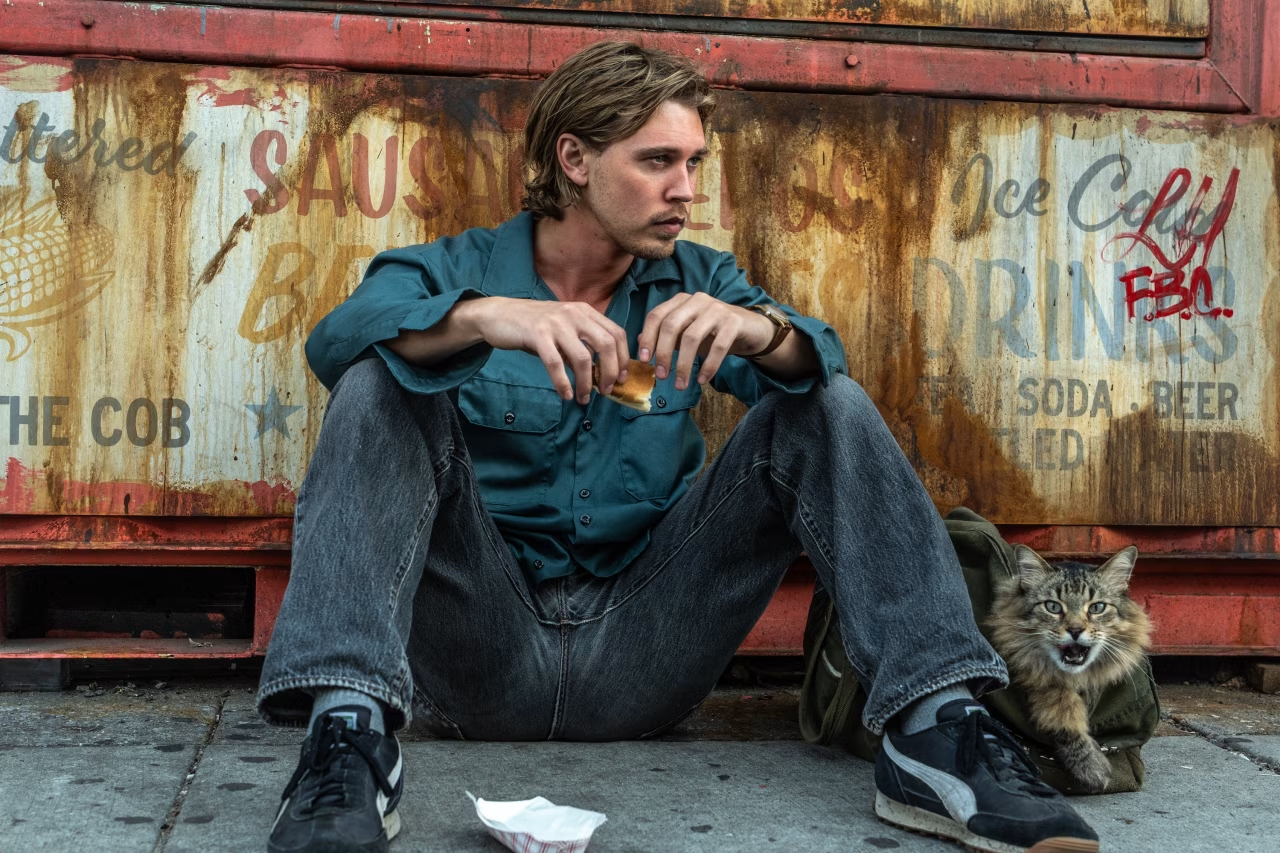
Aronofsky’s answer is Caught Stealing. Set in Manhattan in the late 90s, the film follows the chaotic hijinks that Hank Thompson (Butler) is thrust into when his next-door neighbor, Russ (Matt Smith), leaves town to care for his ailing father. Hank thinks that all he’s doing is cat-sitting, but he quickly becomes embroiled in Russ’s associations with drug-running criminals.
Those associates, including Colorado (Bad Bunny), want the money that Russ owes them. They have no qualms about hurting Hank and his loved ones, including his lover, Yvonne (Zoe Kravitz), to get it. Amidst trying to appease them while also trying to work with Detective Roman (Regina King) in her investigation into them, Hank is recovering from the emotional trauma of a car crash years ago that killed his best friend and destroyed his budding baseball career. The intermingling of his PTSD and his subsequent alcoholism further complicates matters, threatening to ruin his life.

“Destroy” is the name of Caught Stealing’s game, as is Darren Aronofsky’s modus operandi. He puts Hank through worse than hell, tossing him from one chaotic set piece to the next and leaving him with countless physical and psychological bruises. Hank is brutally beaten, has his kidney removed, is threatened with murder, witnesses several murders, witnesses animal abuse, watches a wedding reception get blown up, and is stuck in a crowd with rowdy Mets fans leaving Shea Stadium. Any of these things would drive a well-adjusted man to the brink of insanity. Cramming them all into less than two hours feels especially cruel, even for someone who once had a group of uninvited houseguests devour Jennifer Lawrence’s baby.
And yet, remarkably, Aronofsky successfully balances astonishing trauma with a spry energy laced with sardonic humor and tightly-paced action. It helps that he set the film in the city that never sleeps. He definitely taps the Big Apple’s energy reserves to ignite the film. There’s so much mania on the streets, day and night, that it feels only natural that Hank and his many antagonists would get swept up in it. Even at its most rambunctious — an alley chase here, a speeding car through Flushing Meadows Park there, a gonzo booze-fueled bar bash set to Madonna’s “Ray of Light” at the top — the film stays mostly on the rails for a frenetic but enjoyable ride.

Of course, as Caught Stealing is an unapologetic star vehicle, Austin Butler deserves significant credit as the conductor. Hank is, surprisingly, Butler’s most versatile role to date. It asks him to hit nearly every emotion through the prism of unrealized potential and unresolved grief. Butler hits every beat – carnal, bewildered, gentle, hilarious – with absorbing magnetism, conveyed through his expressive eyes and lithe frame. His ability to draw you in and not let go is critical to making the film work, so much so that it might’ve outright failed without him. Aronofsky understands that and what the budding superstar can offer. It’s why he doesn’t let the camera get too far away from him for too long. Exciting as the set pieces can be, the most striking images are medium or close-up shots of Butler’s searing vulnerability.
There are some things that Butler can’t solve for, though. Caught Stealing is Aronofsky’s most accessible film in years, if not ever. Still, it features its share of metaphysical moments that lead to some tonal confusion and narrative slowdowns. For a fast-paced action dramedy, the film lingers on its quieter moments longer than it should. Aronofsky frames some scenes strangely, such as the wide shot of Hank and Yvonne’s love scene, although that feels intentional. (I can’t speak to the intent, though.) He also focuses a lot of attention on Hank’s past trauma. Specifically, he repeats Hank’s car accident and his violent waking up from some off-kilter nightmare several times. The intent is clearer there: Hank can’t escape his past, no matter how hard he tries. It’s so clear that it risks being a distraction.

Whatever its Aronofsky-isms, the key takeaway of Caught Stealing is Austin Butler. As his first go-around as a leading man (without the aid of Elvis), the film is very successful. He proves that he has the screen presence and acting skills to entertain and captivate an audience. In the 90s or early ‘00s, this would be the type of film that would mark the arrival of a true-blue, butts-in-seats movie star, the kind who you only need to refer to by one name, your Cruise, Brad, Denzel, or Halle. Things are different now, but the film’s existence suggests that the traditional star vehicle may still have a future. It may be quirkier than we’re used to, and might not mark a star’s arrival but rather affirms it.
Someone can indeed become a movie star after receiving an Oscar nomination, and Hollywood may be better for it.



Leave a Reply